 When I first heard someone say, “Ataulfo,” I nearly said, “Gesundheit!” The Ataulfo mango is sometimes referred to as the “champagne mango.” And it makes me think of that line from the Van Morrison song: “She’s as sweet as Tupelo honey,” except I sing it as: “She’s as sweet as Ataulfo honey-mango.” It generally annoys everyone in the vicinity of my voice. Nonetheless, this mango is sweet like a love song.
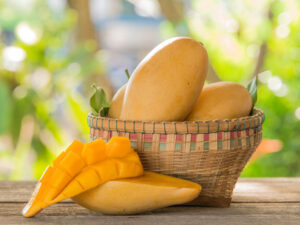
You can pick the Ataulfo out from other mangoes by its yellow color and hook shape at the top. It’s one of the smoothest-eating varieties of mango and doesn’t have the fibrous texture found in other types. When ripe, it will be soft to the touch (and possibly even wrinkled). The fruit will have a velvety texture and a sweet mango taste. It contains a narrow and very thin pit.
One serving (about half a mango) contains nearly 40% of the daily value (DV) of vitamin A, and 15% DV of vitamin C. Mango trees (Mangifera indica) are distant relatives of pistachio and cashew trees. Can you eat the skin of a mango? The skin contains an irritant compound similar to that in the cashew, so don’t eat the skin.
Here’s how to prepare mango!
How to slice a mango
- With a sharp, thin-bladed knife, cut off both ends of the fruit. (Note: always be careful when using sharp knives!)
- Place fruit upright on its wider flat end and cut away peel from top to bottom along the curvature of the fruit.
- Cut fruit into slices by carving lengthwise along the pit.
How to cube a mango
- Stand the mango up on a cutting board stem-end-down and hold in place.
- Place your knife about ¼-inch wide of the centerline and cut down through the mango (you’re trying to miss the pit).
- Repeat on the other side.
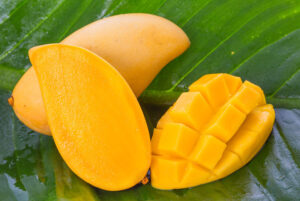
- The resulting ovals of mango are called “cheeks.” Score the inside of each mango cheek about ½-inch deep with a sharp knife, but do not cut through the skin.
- Turn the mango cheek “inside out,” separating the cubes, and scrape the squares off with a knife or spoon.
- Serve and enjoy!
Enjoy and be fruitful! chiefbanana@fruitguys.com
Chris Mittelstaedt is The FruitGuys founder and CEO.