
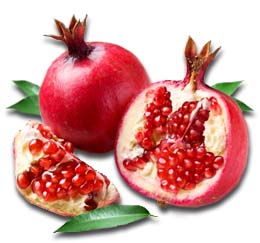
At the Still Life Modeling Agency, the pomegranate gets callbacks all the time. You can see why—it’s such an intriguing fruit. Its beautiful maroon color, its little calyx crown, and it is burgundy skin, which looks like a worn leather suitcase packed full of mysteries, perhaps even love letters. When opened, it reveals a hive of jewels—ruby and garnet arils filled with crimson juice. It’s a beautiful fruit you can spend time positioning “just so” when staging your kitchen counter.
Everyone wants to paint pomegranates. When European still-life painting became its genre in the 1600s, fruit, flowers, and other objects were chosen for their symbolic meaning. For example, a lily was a metaphor for purity; scales meant temperance; and fruits like pomegranates, or poms, denoted religious figures. The pom traveled to Kyoto and Venice via the Silk Road, and most religions imbued it with meanings such as righteousness, bounty, or fertility. Salvador Dalí mentions the fruit in the title of one of his work—Dream Caused by the Flight of a Bee Around a Pomegranate a Second Before Awakening—an illustration of Freud’s observation that external stimuli can manufacture dreams.
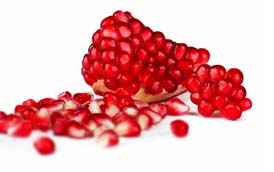
The iconographic pomegranate not only adorns kitchen counters, but also adds the sparkle of its seeds to salads, and livens up couscous or quinoa. Be sure to try it with the other supermodels of the fruit world, like the orange persimmon, or in an exotic salsa with the lively green kiwi. Keep in mind that the juice will stain cutting boards and clothes, so take care unless you’re going for a Jackson Pollock look.
To extract seeds:
Poms can be kept for a long time—but don’t let them be part of the still life for too long! Store for up to two or three weeks on the counter or two months in the fridge. You can tell they’re ripe when the round sides start to square off.
Heidi Lewis writes about farms, bees, and fruit from her home in Sonoma County, CA. She’s been with The FruitGuys since they were FruitKids.