
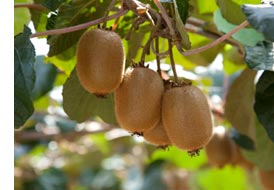
(Throat clearing) “Excuse me—we have a strict ‘no pets’ policy here.”
“I don’t have any pets.”
“What do you call that cute, fuzzy brown thing you’re petting?”
“A kiwifruit.”
(Pause) “Oh.”
Many marketing and branding folks know the story of the kiwi. The fruit is native to China, where it grew wild for centuries until a missionary returning to New Zealand in 1904 brought some seeds home with her. The rest, as they say, is history. In New Zealand, the kiwi was successfully domesticated and prospered. In the 1950s, hoping to break into the U.S. market, New Zealand exporters dropped the fruit’s previous English names—Chinese gooseberry and melonette—in favor of the name “kiwifruit,” after the Maori word for the soft fuzzy bird, whose call sounds like “ki-wiiiii.” After their name change, kiwis were a hit!
 Kiwis now grow domestically, and many varieties have been bred to tolerate various U.S. climates. They are not self-pollinating, and, are dioecious—meaning the plants come in sexes—so pollinator help is needed. Well-behaved fruits, kiwis grow on a vine and are often trained to large overhead arbors. They are also easy to transport.
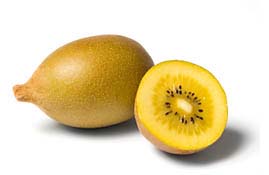
There are numerous cultivars of kiwi—the familiar Hayward kiwi, with fuzzy brown skin and green flesh; golden kiwifruit, with minimal fuzz and gold flesh; and the much smaller kiwi berry, which has smooth, fuzz-free skin. These varieties range in flavor from sweet to sweet-tart. Kiwi berries are always eaten with their skin, but the fuzzy skin of Hayward and golden kiwifruit is also edible—though whether you’ll want to eat it or not might depend on how adventurous you’re feeling! The oil from kiwi seeds contains alpha-linolenic acid, an omega-3 fatty acid, which as a supplement has become an odorless alternative to fish oil. And Kiwis are vitamin powerhouses—a medium-size kiwi contains around 120 percent of the recommended daily value of vitamin C and over 300 mg of potassium.
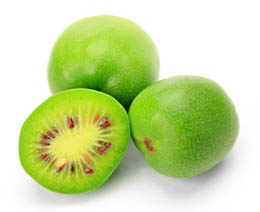 Preparation: Kiwis are ripe when they give slightly to pressure. They’re easy to eat peeled and sliced, or cut in half and eaten with a spoon. Kiwi berries are even easier—just pop them in your mouth like grapes! The adventurous smoothie maker can rinse kiwis in cool water, remove the ends, and throw the fruit, skin and all, into the blender.
Storage: Keep kiwifruit at room temperature until ripe. Once ripe, kiwi will keep in the fridge for a couple of days. Unripe will keep refrigerated for up to two months.
Enjoy & Be Fruitful! – Chris Mittelstaedt chiefbanana@fruitguys.com