
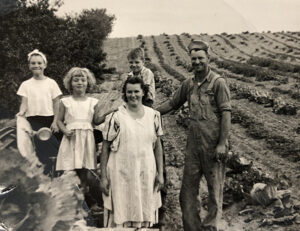
The USDA classifies family farms as “any farm organized as a sole proprietorship, partnership, or family corporation.” But a cold definition is never the whole story, is it? Mick Klug grew up on his family’s farm. His parents established their 40-acre farm in the 1930s. The reason you often hear of farms being in parcels of 40 acres is because of the way surveyors used to map large swaths of American land. According to the Public Land Survey System, “In 1832, the smallest area of land that could be acquired was reduced to the 40-acre, quarter-quarter section, and this size parcel became entrenched in American mythology.”
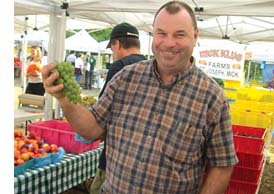 Mick took ownership of the farm in 1974 and has since grown it to 120 acres. He farms it with his wife, Cindy, and daughters, Amy and Abby—and their golden retriever, Lily. Most people would agree that land farmed for three generations defines “family farm.” And a man who says, “working with the earth and my hands is my favorite part of farming” defines “farmer.”
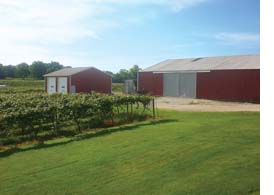
Parts of the farm nap under a blanket of rye cover crop in winter. But winter means catch-up time for the Klug family. “We catch up on paperwork and get organized for the next growing season. We also prune grapes and tree fruit and work on equipment. We plan what is going to be planted in the spring, how much of it, and where. We also attend trade shows and educational conferences. And take a few naps,” says Abby. “Depending on how well we do during the summer, we are sometimes able to take a vacation sometime between November and March.” They deserve a vacation. A farmer’s work is from pre-dawn until dusk, “We get up at 2:30 [a.m.] on market days and around 4:00 a.m. on others,” she adds.
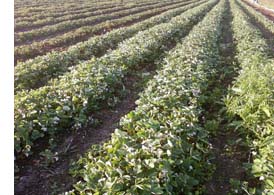 Mick Klug Farms is known for its luscious asparagus (purple and green), varieties of annual vegetable crops, tree fruit, and berries. Managing diverse crops—from asparagus, green beans, carrots, cucumbers, peas, rhubarb, tomatoes, apples, apricots, blueberries, blackberries, raspberries, strawberries, cherries, grapes, nectarines, peaches, and pears—you would expect fancy machinery. “Our tools are our brains and our hands!” says Mick. Add to that pruning shears, tractors, and trailers.
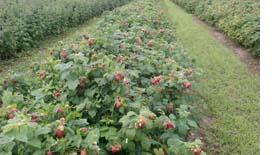 The quality and variety of Klug’s produce has earned the farm a good reputation from Chicago chefs and regulars of the Green City Market. TimeOut Chicago online said about Mick: “[He’s] kind of the Thomas Edison of farming.”¦he’s a serial experimenter—he’ll grow 15 different varieties of peaches”¦just to see which tastes best.” The Klugs also put in a huge freezer so they are able to save summer’s plenty of fruit for leaner times in winter. Famed chef Rick Bayless, who has purchased from Mick Klug Farms for 25 years, relies on their winter supply of frozen fruit, which allows him to feature winter fruit crisps and an upcoming line of local-fruit smoothies for his Frontera restaurants.
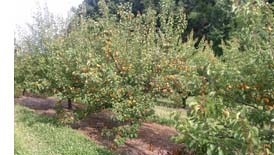 Farming with family, growing a diverse crop, and supplying Chicago with wholesome food isn’t the whole story either. Mick employs organic practices with some of his crops and sustainable principles on the farm, which recently received certification from the Michigan Agriculture Environmental Assurance Program (MAEAP). MAEAP certification means they are “environmentally verified.” The program is voluntary, with the aim of assuring effective land stewardship practices. Since 2000, a thousand Michigan farms have qualified.
For Mick, there’s a statistic about farming he learned at an agriculture conference a while back that has always stuck with him: “the average U.S. farmer feeds 155 people.” Using land stewardship principles, small family farms like the Klugs are reaching many more generations than just one.
Heidi Lewis writes about farms, bees, and fruit from her home in Sonoma County, CA. She’s been with The FruitGuys since they were FruitKids.