
How do you know if a fruit, vegetable, or snack is GMO (genetically modified)? For years, this question was tough to answer. There weren’t official rules around labeling GMOs, so people who wanted to avoid them had to cross-check lists of GMO products from multiple sources and hope for the best. But in 2022, that changed.
Since 2022, you may have noticed round “bioengineered” or “derived from bioengineering” labels on some items in the grocery store or your office break room. This label makes bioengineered foods stand out, but it raises its own questions: Is “bioengineered” the same as GMO? Who regulates the label? And which foods have to carry it?
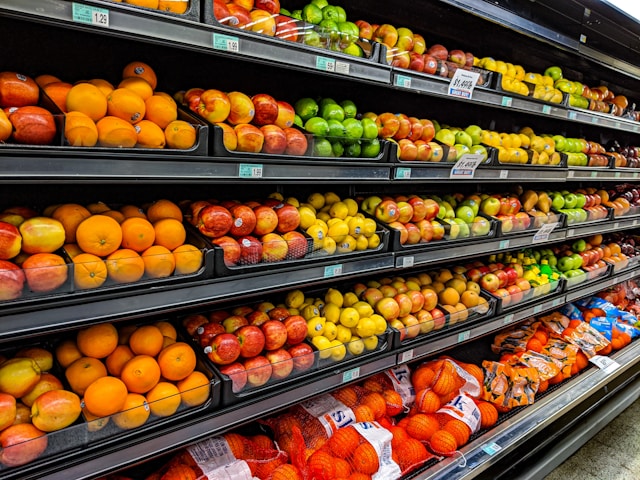
We dug into the data and spoke to both GMO fruit developers and GMO labeling advocates to get those answers for you. Here’s a crash course in navigating these labels while you shop.
“Bioengineered” (BE) and “genetically engineered” (GE) are trending terms used to describe GMOs, or genetically modified organisms. Essentially, the term GMO has fallen out of fashion. New regulations and scientific articles often use BE or GE instead.
The United States Department of Agriculture (USDA) defines a bioengineered food as “A food that contains genetic material that has been modified through in vitro rDNA techniques and for which the modification could not otherwise be obtained through conventional breeding or found in nature.”
We’ll use the terms BE and GMO interchangeably in the rest of this article.
These new labels for GMO foods have been in the works for a long time. In 2016, Congress passed the National Bioengineered Food Disclosure Law, which required the USDA to come up with a consistent labeling framework for bioengineered foods across the country.
In 2018, the US Secretary of Agriculture announced the new National Bioengineered Food Disclosure Standard (NBFDS) that did just that. The new labeling rules went into effect in 2022, but they’re flexible—the USDA Agricultural Marketing Service reviews the GMO landscape annually and recommends new foods to add to its List of Bioengineered Foods.
The latest update, which went into effect in 2023 and will be enforced starting June 2025, added varieties of sugarcane to the list and adjusted the listing for summer squash.
Developers of BE foods can choose from four different labeling options.
You can look for these disclosures on the item’s packaging, ideally on the front or near the manufacturer information. However, all of these options mean that it may still take some effort on your part to find out if a particular fruit, vegetable, or snack is BE.

Here’s where things get complicated. Some BE foods are exempt from the labeling requirements, and so are some retailers that sell or distribute them.
The Non-GMO Project—which offers a certification for non-GMO products—told The FruitGuys that because of these exemptions, it’s concerned that the labeling rules aren’t transparent enough to help customers understand what they’re eating.
“By focusing on detectable modified material, NBFDS overlooks many products made from GMOs,” a spokesperson told us. “For example, granulated sugar made from GMO sugar beets, or canola oil from GMO canola. In both cases, the source crops are GMOs, but the processing that happens before the product appears on a store shelf doesn’t leave enough detectable modified genetic material to yield an accurate test result, so neither product would require a BE label. Ingredients derived from GMOs often end up as inputs in highly processed products, so the same limitation exempts many products made from GMO corn or soy.”
Fresh, whole fruits and vegetables sold in grocery stores typically need to be labeled, which is good news if you’ve wondered how to know if a fruit is GMO.
To get a GMO fruit developer’s perspective, we spoke to Sarah Davidson Evanega, the vice president of business development at Okanagan Specialty Fruits (OSF). OSF is the company behind Arctic® apples, which are sold pre-sliced and engineered not to brown—a strategy that prevents food waste.
Evanega told us that OSF was ahead of the curve on labeling its products, which reached the market in 2018.
“OSF is proud of the technology we use to develop our superior products that bring benefits to both people and the planet. As such, we have been committed to being very open and transparent about the technology we use to develop our products. We have always made that apparent on our consumer-facing packaging from day one,” she said.
Nathan Pumplin, the CEO of Norfolk Healthy Produce, told The FruitGuys that he’s also in favor of the labeling rules. Norfolk Healthy Produce developed The Purple Tomato™. It includes genetic material from the Snapdragon flower, which gives it bright purple skin and flesh, and extra anti-inflammatory properties.

“The labeling rule is strongly positive in my view,” he said. “It provides transparency to consumers, [helping them] choose foods that align with their values.”
Initially, Pumplin said, retailers and developers were concerned that consumers “would see ‘Bioengineered’ as a warning” and change their shopping habits. But so far, he hasn’t heard about any negative effects of the labels from his peers in the produce and grocery industry. He told The FruitGuys that instead, anecdotal evidence—like the recent success of the BE pink pineapple—shows customers are embracing BE foods.
“There were retailers concerned about the introduction of the label, and they found no consumer pushback when the labels began,” he said.
If you’ve found yourself standing in a grocery store aisle wondering, “How do I know if this fruit is GMO?”, then hopefully we’ve shed some light on the topic. Ultimately, spotting GMO/BE fruits, vegetables, and snacks is still tricky, but the USDA’s BE labels are helpful to have in your shopping toolbox.
One place you don’t need to look for the label is on your office fruit delivery from The FruitGuys—we only include non-GMO produce in our fruit and vegetable delivery boxes! To learn more about that and the difference between GMO and non-GMO fruits, check out “Your Guide to Non-GMO Fruit Delivery: What It Means and Why It Matters.”