
What happens when a California fruit farm works with nature instead of against it? Stroll through the orchard at Earthseed Farm in Sebastopol and you’ll quickly find out.
The farm is lush and green, abundant with Asian pear and persimmon trees. Earthseed’s team uses compost to enrich the soil, captures and redistributes rainwater, and controls pests with natural predators.
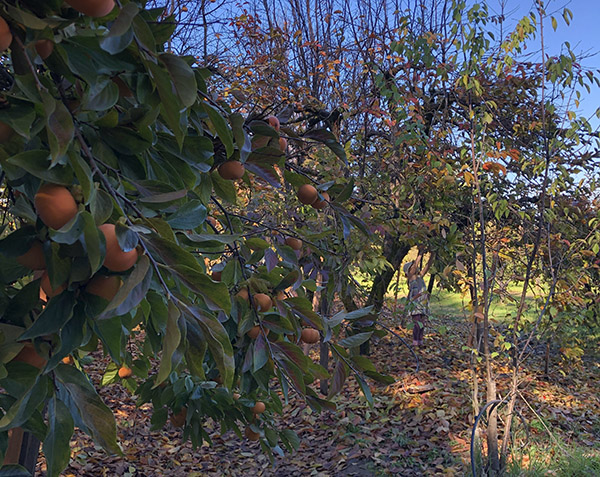
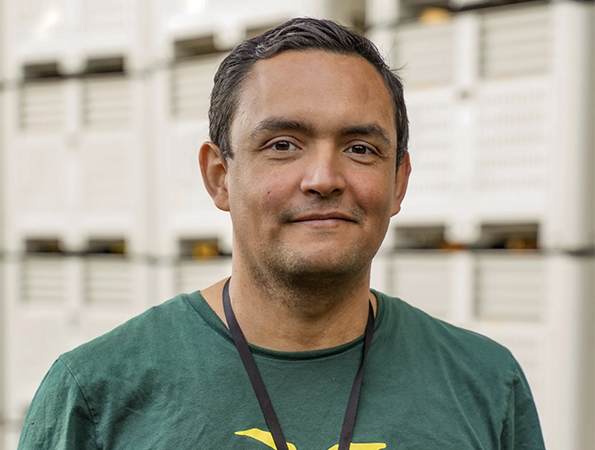
“The soil just gifts you and gifts you and gifts you, and the soil really doesn’t ask for anything,” operations manager Juan Hernandez told The FruitGuys.
Earthseed has partnered with The FruitGuys since 2021. Our customers love the farm’s fall crops, including the juicy Asian pears and spiced persimmons we add to our office fruit deliveries.
Pandora Thomas founded Earthseed in 2021 as a hub for the local community, especially her Black neighbors. Only 1.4 percent of American farmers are Black, and Earthseed is one of just a few Black-owned farms in California. The fourteen-acre organic nonprofit farm runs on solar power and doubles as a community space and education center. Locals can take a tour, pick fruit, or learn about the farm’s Afro-Indigenous permaculture practices.

Pandora picked the farm’s name out of famed Black sci-fi writer Octavia Butler’s book Parable of the Sower, a post-apocalyptic climate change novel set in California. In it, survivors follow a religion called Earthseed that focuses on embracing change and building community. There’s a mural of Butler on one of Earthseed Farm’s outbuildings to keep her wisdom top of mind.
“People come here to improve the land, improve trees, care about trees, and care about each other, and you can see that in everything [we do],” Juan said. At Earthseed, caring for the land starts with Afro-Indigenous permaculture.
Permaculture is a kind of agricultural design that involves working with nature rather than against it. The version practiced at Earthseed, Afro-Indigenous permaculture, also elevates the ecological principles and legacies of people of Afro-Indigenous ancestry.
“It’s observing what’s going on with the land or with what you want to work with, and going back to the means of nature. Everything is related,” Juan said.
Farmers and gardeners who practice permaculture follow a set of principles outlined by David Holmgren, one of the creators of the method. Here are just a few of them:
As the Earthseed website puts it, “Permaculture is rooted in what Black and Indigenous communities have always been doing, which are principles of life.”
Juan told The FruitGuys that in his three years at Earthseed, he’s seen the California fruit farm’s crops flourish under this system.
Earthseed grows delicious Asian pears, persimmons, apples, pineapple guavas, berries, plums, pluots, and more. Its team calls these crops “Fruit Kin” because they believe everything is related. As Juan explained it, “Earthseed recognizes the land, animals, and fruit as our more-than-human kin.”
We look forward to Earthseed’s fall fruit every year, especially its Asian pears and persimmons!
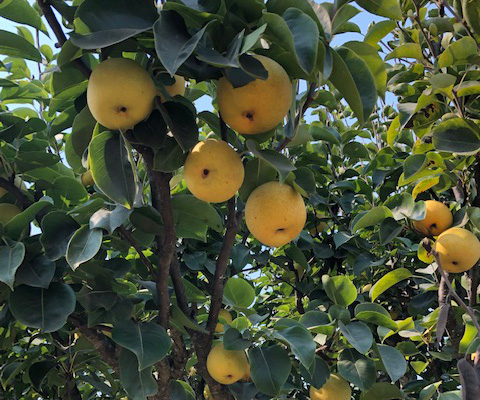
Earthseed’s harvest of 4,000 Asian pear trees starts in August with Hosui, Chojuro, 20th Century (a FruitGuys favorite), and Shinseiki pears. It continues through September with Shinko, Yoinashi, Olympic, and Niitaka pears. Finally, Ya Li Asian pears ripen up in October and finish out the season.
“Niitakas are always fun. These are giant pears—one pear can weigh more than two pounds!” Juan said. “My favorite is Shinseiki. It’s not really most people’s favorite because it’s not as sweet as the other ones, but it’s very juicy and super fresh. Chojuro is good for a lot of stuff—it has a sweet, perfumey taste, with a stronger taste in the skin. Fruit cider makers use it a lot for its strong flavor.”
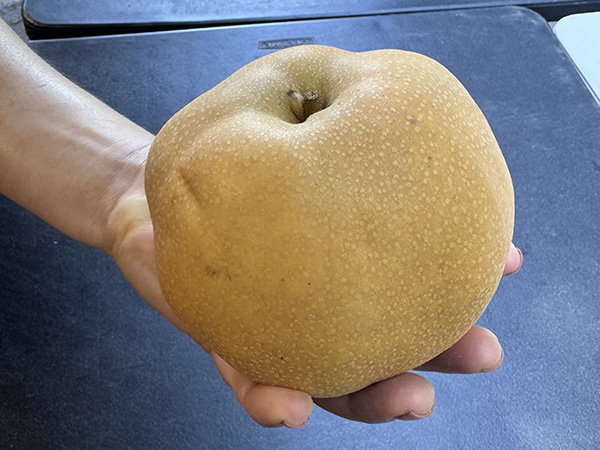
This was an unusual year for Asian pears. Earthseed grew a bountiful crop, but because it was a more overcast summer, the pears didn’t change color as quickly as they usually do on the trees. To find out if they were ready for harvest, Juan and his team tested their Brix (sugar content) and discovered that even the green ones were ripe and ready.
When we spoke, Juan’s team had just finished harvesting its Ya Li Asian pears. Many Asian pears are round (hence the nickname “apple pears”), but Ya Lis are yellow-green and pear-shaped, with a crisp texture, sweet-tart flavor, and hints of fall spices.
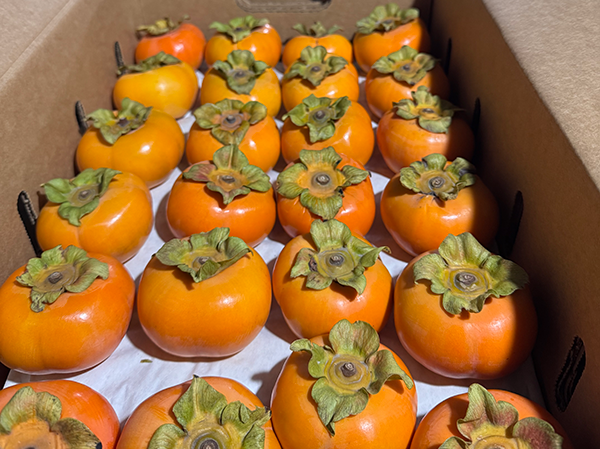
Earthseed grows both Hachiya and Fuyu persimmons, and Juan is expecting a bumper crop when harvest begins in November.
“The trees are looking beautiful. This season we have a lot of fruit—some of the branches were breaking because of the weight of the fruit, even though we take care of the trees and put bolsters in the branches!” he said.
Hachiya persimmons are acorn-shaped, soft, and great for baking. Fuyus are shaped like squat tomatoes, and you can eat them firm, so they’re better for snacking. Both varieties are sweet and creamy, with hints of vanilla and spice.
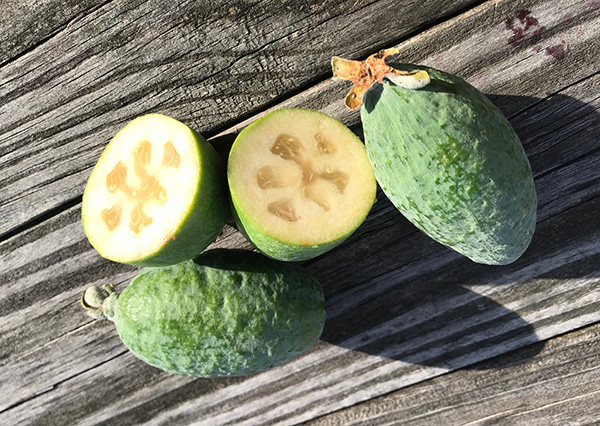
Pineapple guavas (aka feijoas) are one of Earthseed’s lesser-known crops. They’re green, oval-shaped fruits with fronds on one end and jellied sections in the middle. To eat one, you can cut it in half and scoop out the sweet-tart center, or slice it into quarters and eat it like an orange.
“It’s super sweet inside with sour outside, and the skin is bitter. Most people don’t eat it with the skin, but I do. I like the contrast between the sour, the sweet, and the little bitterness of the skin,” Juan said.
California fruit farms like Earthseed typically harvest pineapple guavas from October–December.
If you’re in the Western US, you can get a taste of Earthseed’s fruit in The FruitGuys’ fresh fruit mixes. We deliver them to offices, schools, and homes, and the fruits inside change with the seasons!
You can also visit Earthseed yourself. Take advantage of its u-pick days from July through November, or book a tour or retreat for your team. It’s a great way to connect with the land and learn about Afro-Indigenous permaculture from one of the few Black-owned farms in California.
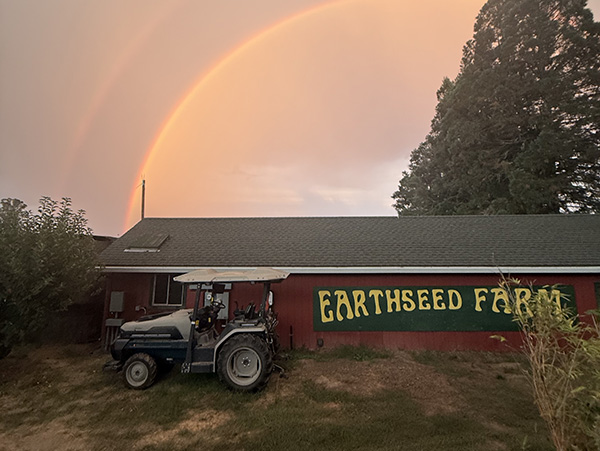
When we asked Juan what makes the farm special, he said, “The people here put their heart into what they do.” They care for the land, care for each other, and collaborate rather than compete.
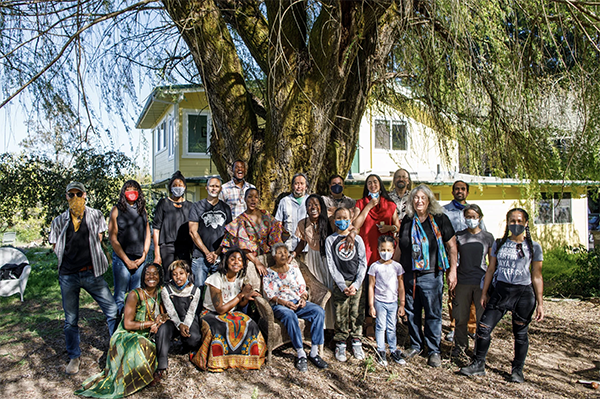
Juan worked in corporate jobs and raised water buffalo in his native Colombia before moving to the US for his safety. He found Earthseed by chance, and the farm embraced him.
“I think there’s a perfect balance between nature and us as human beings,” Juan told us. “And after working in several industries, I think this is the only thing that aligns with my principles.”
We’re proud to partner with a California fruit farm that truly values nature, community, and its workers, and hope we can continue our partnership for many years to come!