
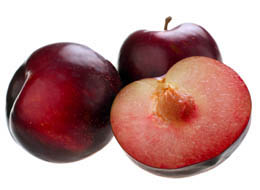
 Maybe you think I write too much about my kids. I kind of agree, but man, do they give me good material. Last week, for example, when I told them we would be getting pluots for this week’s cases, they ran with it. “Plupups?” my daughter said. “No,” I said, “pluots.” “Dad’s getting plu-pots next week!” my other daughter yelled across the house. “Plops?” my son said as he walked in the room. “No, PLU-OTs,” I enunciated. “It’s a cross between a plum and an apricot.” “Mom, dad’s getting plutons for next week!” I understand their confusion.
As a matter of fact, when we first started seeing pluots from farmers and including them in cases, we got lots of questions about exactly what they were and if they were a modified fruit. First, let me be clear—we never put anything into our cases that is genetically modified. Pluots are hybridized fruits. They’re a more complex hybridization than a plumcot, which is half plum, half apricot. Hybridizations happen both naturally and in a controlled manner. It’s not quite as simple as that commercial where a girl on skates eating a chocolate bar collides with a boy holding a jar of peanut butter and they have a “Eureka!” moment. Basically, it’s when the material from two blossoms (through cross-pollination) mix to create a new fruit.
Floyd Zaiger is credited with developing the pluot, and he has taken a note from Gregor Mendel’s book—the Augustinian monk who, starting in the late 1850s, began to cross-breed different strains of pea plants and noticed that he could predict their characteristics. He theorized that there was an inherited basis for genetic traits. Today, farmers take a structured approach to hybridization. They say it takes a lifetime to hybridize a new fruit. If keeping a fern on your desk alive is challenging, then you’ve got to appreciate what goes into breeding fruit. When hybridizing a fruit, it’s important not to allow any bees or wind to mess with your program (or you might end up with pluot-peach or something less desirable). When and if the progeny emerges—and it has the characteristics you’re looking for—you take its seed and grow a tree. You keep growing and growing new trees, continuing to expose your original blossom to new pollen and hoping for the best.
Pluots are said to be somewhere around three-fifths plum and two-fifths apricot. Apriums, another Floyd Zaiger hybrid, is the flipside of this combination. I find pluot varieties to have more vibrant tart and-sweet tastes than their more quiet plum cousins. Most pluot production in the U.S. is coming out of California right now. Pluot varieties appearing in some of our cases this week include Dapple Dandy, Dapple Fire, Flavor Supreme, Sugar Jewel, and Sweet Treat pluots, all from Twin Girls Farm in Yettem, CA. Try them and let us know what you think! Check out your region’s mix at fruitguys.com/mix.
Enjoy and be fruitful!
Chris Mittelstaedt is the founder and CEO of The FruitGuys.