
By Heidi Lewis
People are rarely ambivalent about mushrooms. Whether a treasured morsel or not, many of us find it hard to distinguish between varieties we adore. Enter “The Kingdom”—The Fifth Kingdom of Biology, that is. The Kingdoms are Animal, Plant, Protista, Monera—and Fungi. When entering this kingdom, it helps to know your Latin for proper identification. “Ee-they ushrooms-may in-ay ee-they est-way oast-cay AkeHome-tay ases-cay is-they eek-way are-ay aitake-May.” (Translation: The mushrooms in the west coast TakeHome cases this week are Maitake.)
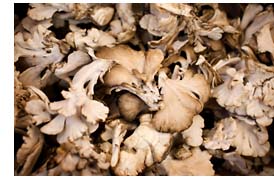
Maitake is native to East Asia, where they grow on hardwood trees—they also grow wild in North America (mostly in the northeast), and wherever intrepid mushroom hunters find them, they are a rare boon. Back in Shogun-era Japan, Maitake mushrooms were worth their weight in silver. In the U.S., the Maitake is known as “Hen of the Woods,” yet its Japanese name, which means, “dancing mushroom,” is a good description of its flouncy skirts. It may have also gotten the name because people would dance when finding them.
Growing fungi for food is a controlled scientific enterprise. The growers at Hokto Kinoko, in San Marcos, CA, have a state-of-art facility and employ environmental practices, as they are committed to all aspects of “research, development, and production of mushrooms as a superior health food.”
 Mushrooms like Maitake have long been our companions as food and medicine. Maitake is known for their robust earthy characteristics and may seem hardly medicinal, but recently the Maitake has undergone scientific scrutiny to understand its great positive health benefits. It contains polysaccharides (beta-glucans) that stimulate the immune system and are being evaluated for fighting cancer.
The Fungi Kingdom still has many mysteries for us to discover, and many everyday mushrooms, as well as special delicacies such as the Maitake, are a doorway into the intriguing mycelium world. It’s lucky for humankind that they’re so tasty too. To learn more about mycelium, check out Mycelium Running: How Mushrooms Can Help Save the World, by Paul Stamets.
Maitake separates easily and is clean and ready to cook. Cook minimally (1–3 minutes) with anything you’d use button mushrooms for.
Keep in an airtight container in the fridge. Use sooner for better flavor. They’ll last up to 5 days and may also be frozen.